4 Months Hands-on Training to Transition your Career into AI
The Azure AI/ML and Generative AI Program is designed to cover essential
areas, including mastering Python, Machine Learning, and Azure AI and
Generative AI. Participants will gain expertise in implementing workloads and
security within the Azure framework, skillfully creating and deploying applications
in Azure, and ensuring robust data security.
This curriculum provides a comprehensive and hands-on understanding of Azure,
preparing you to excel as a proficient Azure AI/ML Engineer.
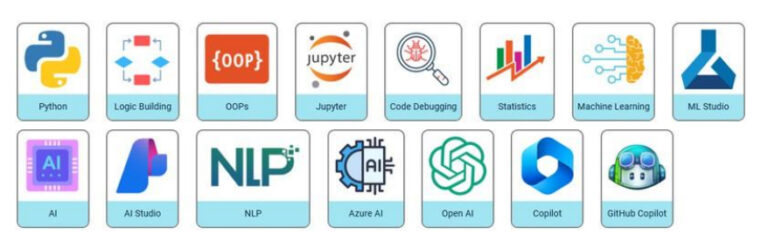
Tools and Technologies Covered
Course Curriculum
Module 1: Python for AI/ML
Python Programming
➢ Introduction to Python Programming
➢ Variables, Data Types & Operators
➢ Data Structures
➢ Functions
➢ Conditional Flow statements
➢ Lambda, Map, Filter functions
➢ Error Handling
Python for Data Science
➢ Mathematical Computing using NumPy
➢ creating 1d, 2d and 3d arrays
➢ Accessing Array Elements
➢ Indexing, Slicing, Iteration
➢ Data Analysis using Pandas
➢ Understanding Pandas
➢ Series & DataFrames
➢ DataFrame Operations
➢ Filtering, Grouping and Joining
➢ Loading Data from Datasets to DataFrames
➢ Data Visualization using Matplotlib
➢ Different types of Plots & Charts
Module 2: Statistics & EDA
➢ Introduction to Descriptive Statistics
➢ Data & Variables in Statistics
➢ Measures of Central Tendency (Mean, Median & Mode)
➢ Variance & Standard Deviation
➢ Univariate Analysis (Histograms, Box plots & Bar charts)
➢ Bivariate/Multivariate Analysis (Line plots, Scatter plots, Heat maps)
➢ Probability Distribution & Central Limit Theorem
➢ Hypothesis Testing & Inferential Statistics
Module 3: Machine Learning
➢ Introduction to Machine Learning
➢ Types of Machine Learning
➢ Steps to build an ML Model
➢ Supervised ML vs Unsupervised ML
➢ Supervised Learning: Regression & Classification
➢ Unsupervised Learning: Clustering
➢ Linear Regression: Simple & Multiple
➢ Gradient Descent
➢ Logistic Regression
➢ Decision Trees & Random Forest
➢ KNN algorithm
➢ K-means Clustering
➢ Regression Metrics
➢ Classification Metrics
➢ Overfitting & Underfitting
➢ Bagging (Ensemble Methods)
➢ Boosting (Ada Boost, XG Boost, Gradient Boosting & Stacking)
➢ Feature Engineering
➢ Model Tuning & Performance
➢ Optimization Techniques to improve ML models
Module 4: Deep Learning & NLP
➢ Introduction to Neural Networks
➢ Types of Neural Networks
➢ Computer Vision
➢ Natural Language Processing (NLP)
Module 5: Artificial Intelligence & Generative AI
➢ Introduction to Artificial Intelligence
➢ History of AI
➢ Types of AI
➢ Areas and related disciplines of AI
➢ Understanding AI Subdomains
➢ Applications of AI
➢ Tasks AI can solve
➢ Introduction to Generative AI
➢ Evolution of Gen AI
➢ Gen AI vs Traditional ML
➢ How Gen AI works
➢ Applications of Gen AI
➢ Popular Gen AI Tools
➢ Introduction to ChatGPT
➢ Large Language models (LLM)
➢ Developing Gen AI models: Transformers
➢ Prompt Engineering
➢ Building Gen AI models on Azure
Module 6: Azure AI Engineer Associate
➢ Getting started with Azure AI Services
➢ Azure Machine Learning Studio & Workspace
➢ Design a Machine Learning Solution with Azure ML Studio
➢ Model Deployment with Azure ML
➢ Create Computer Vision solutions with Azure AI Vision
➢ Develop NLP solutions with Azure AI Services
➢ Develop solutions with Azure AI Document Intelligence
Module 7: Generative AI using Azure OpenAI Service
➢ Introduction to Azure OpenAI Service
➢ Building NLP solutions using Azure OpenAI Service
➢ Apply Prompt Engineering with Azure OpenAI Service
➢ Generate Code with Azure OpenAI Service
➢ Implement RAG with Azure OpenAI Service
➢ Generate Images using DALL-E
➢ Exploring the Azure Machine Learning Workspace
➢ Make data available in Azure ML
➢ Working with Compute resources in Azure ML
➢ Train a model with the Azure ML Designer
➢ Designing a Data Ingestion strategy for Azure ML
➢ Designing a Model Training strategy for Azure ML
➢ Working with Automated Machine Learning in Azure ML
➢ Finding the best Classification model with Automated ML
➢ Track model training in notebooks with MLflow
➢ Run Pipelines in Azure ML
➢ Deploy an MLflow model to a batch endpoint
➢ Deploy an MLflow model to an online endpoint
➢ Exploring Azure AI Services
➢ Analyze Images in Vision Studio
➢ Analyze text with Language Studio
➢ Use Question Answering with Language studio
➢ Extract form data in Document Intelligence studio
➢ Explore Microsoft Copilot
➢ Explore Azure OpenAI Service
➢ Explore Content filters in Azure OpenAI
➢ Analyze Images with Azure AI Vision
➢ Image Classification with custom Azure AI Vision models
➢ Object Detection in images with Azure AI Custom Vision
➢ Detect, Identify and Analyze Faces with Azure AI Vision
➢ Reading Text in Images
➢ Build Azure AI services Conversational language understanding model
➢ Analyze and Classify Text
➢ Translate Text with Azure AI Translator service
➢ Creating a Search solution using Azure AI Search
➢ Creating a Knowledge store using Azure AI Search
➢ Analyze documents using Azure AI Document Intelligence
➢ Extract data from Custom Forms
➢ Apply Prompt Engineering with Azure OpenAI Service
➢ Generate and improve code with Azure OpenAI Service
➢ Implement a RAG model with Azure OpenAI Service
➢ Generating images with DALL-E model
Real World Projects
1. Food Hub Order Analysis
perform exploratory data analysis and provide actionable insights for a Retail
Food company.
Tools: Python Pandas, Seaborn, Statistics and EDA
2. Loan Prediction model
build a ML model to identify the customers of a bank having a higher probability
of purchasing a loan.
Tools: Pandas, Seaborn, Machine Learning
3. Immigrant Visa Prediction model
build a ML predictive model to facilitate the Visa approval process.
Tools: EDA, Machine Learning
4. Credit Card Churn Prediction
build a ML predictive model to predict whether or not a customer will discontinue
using a bank’s credit card services.
Tools: Machine Learning
5. Customer Product Review Analysis
Tools: Generative AI, Transformers, LLMs, Prompt Engineering
6. Building RAG application with Langchain
Tools: Generative AI, Langchain
7. Movie Recommendation system with Azure ML
Tools: Azure Machine Learning
8. Fortune Wheels Data Analysis
Tools: Data extraction and aggregation, SQL Functions, Joins and Subqueries
9. Build your own Chatbot
Bonuses
✓ AI/ML Interview questions & answers
✓ Real-time scenarios and solutions
✓ Mock Interviews
✓ Placement Assistance
✓ Azure AI-102 and DP-100 certification support
✓ Resume/CV preparation
✓ Building Project Portfolio
✓ LinkedIn profile optimization
✓ On-Job Support
Target Jobs
Post training you will be able to successfully apply for the following AI jobs:
✓ AI Engineer
✓ Machine Learning Engineer
✓ Data Scientist
✓ Generative AI Engineer
✓ Azure Cloud AI/ML Engineer
Program Outcome
✓ Transition your career to AI/ML Engineer
✓ Land high-paying AI jobs globally
✓ Up to ~300X times increment in your current salary
✓ Switch to Top IT & Product based companies
✓ Have a secured career and work in a Future trend
✓ Become a top & highly paid IT professional
Azure AI/ML Engineer Career Scope
Why Become Azure AI/ML Engineer?
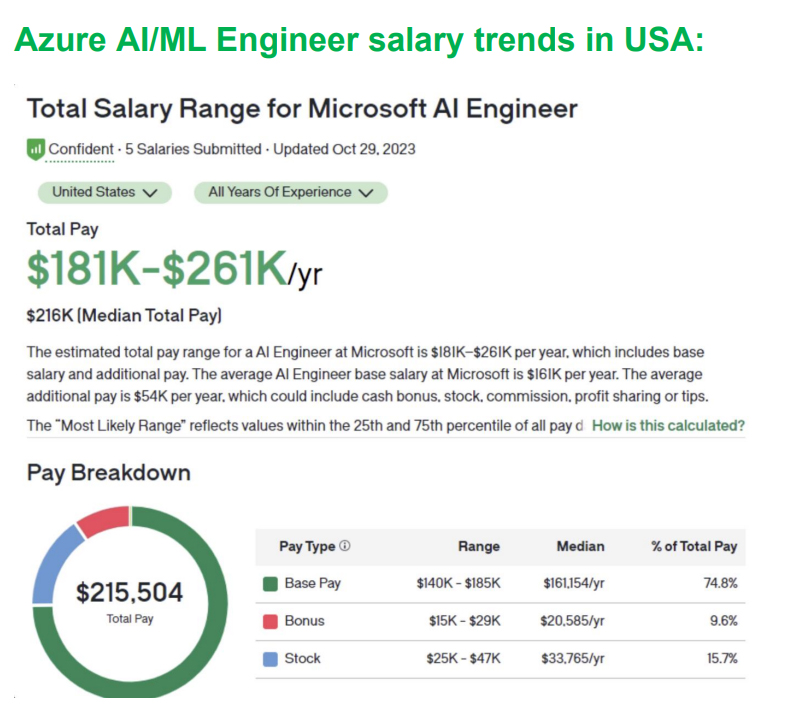
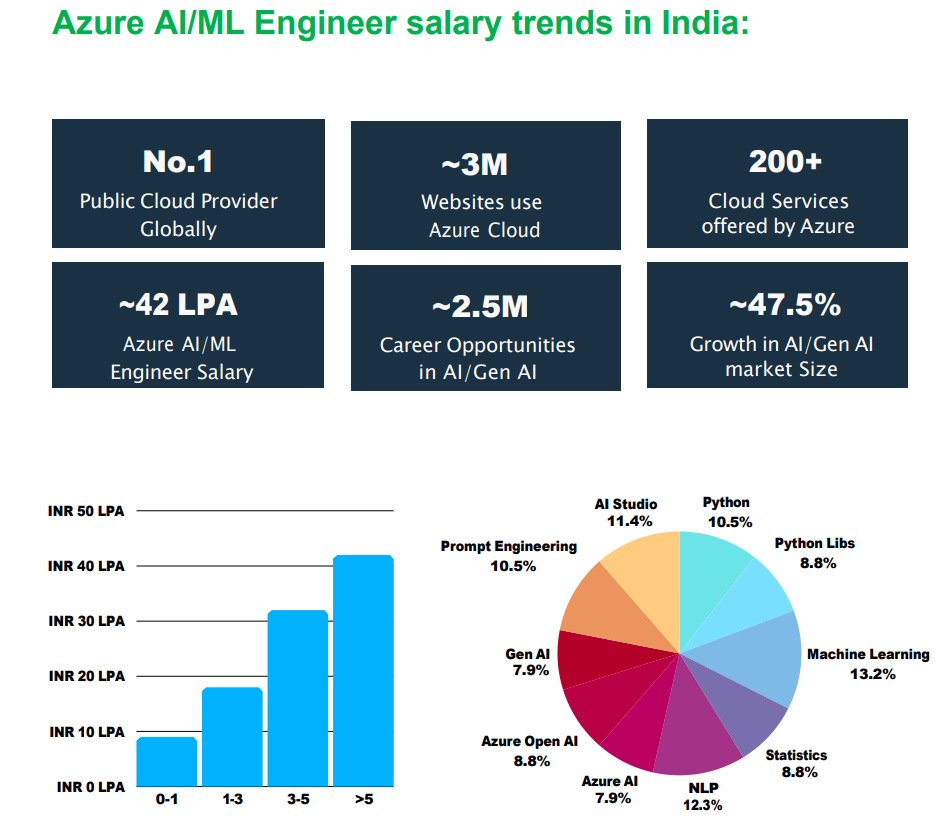
Becoming an Azure AI/ML Engineer or Azure Data Scientist offers a dynamic career with high demand and competitive salary globally. These stats back the statement.